Why You're So Tired That Sleep Doesn't Even Fix It
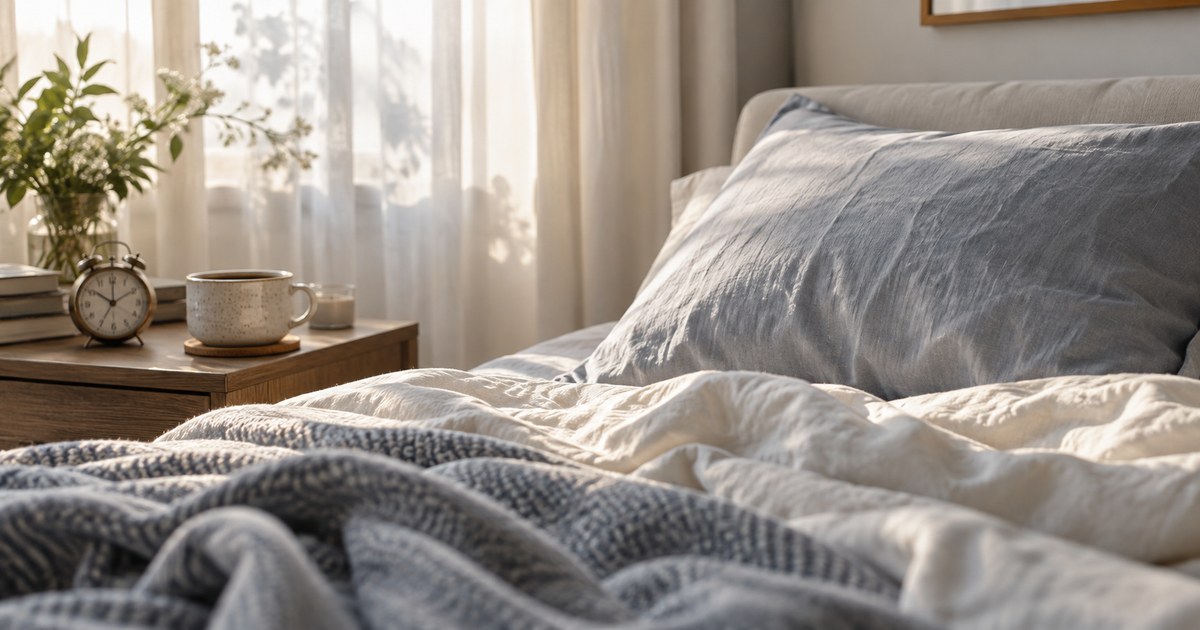
I woke up one Tuesday morning last spring and just sat down on the kitchen floor. Not because anything had happened. I'd slept eight hours. Nothing was wrong, technically. I just couldn't make myself stand up yet.
I remember thinking: this isn't tired-tired. This is something else.
If you've searched something like "why am I so tired all the time" and landed here, I want to say the thing I wish someone had said to me that morning on the kitchen floor: you are not broken. You are not failing at rest. Something else is going on, and it has a shape, even if nobody's ever pointed at it and named it for you.
Why you're tired even after eight hours of sleep
For years, "tired" meant I hadn't slept enough, so I'd sleep more. It didn't work. I was tired in a way that eight hours didn't touch. Bored in a way scrolling didn't fix. And snappish for no reason — I'd bite at the cat, at the coffee grinder, at nothing at all.
I didn't have a diagnosis. I wasn't sick. I was just... a woman who had been the one holding everything together for a very long time, and my body had finally sent a memo about it.
I spent twenty years being useful — the one who kept the calendar and, when it came to it, kept the peace. I was the infrastructure everyone leaned on, and infrastructure is only ever noticed when it fails.
If any of that sounds familiar, I don't think it's a coincidence. I think this is what a decade, or two, or three, of being everyone's infrastructure actually feels like from the inside.
What I tried first (and why it didn't work)
I want to be honest about this part, because I think it's the part that keeps women stuck the longest.
I tried the bubble bath. I tried the face mask, the "self-care Sunday," the fancy candle. None of it was wrong, exactly: a warm bath is a genuinely nice twenty minutes. But a bubble bath was never going to touch what I was actually carrying. You cannot bath your way out of a decade of putting yourself last. I know, because I tried.
I also tried planners. I had, I'm not exaggerating, a drawer of them. Beautiful ones, leather ones, a $40 one I bought thinking a serious purchase would finally make me a serious, disciplined person. I'd fill in the first week. By week three it was gathering dust, and I'd feel one more small failure stack quietly on top of all the others.
What I eventually understood is that none of it was a "me" problem. I didn't need a bigger system. I needed something so small it couldn't fail, and I needed to stop treating rest like a prize I hadn't earned yet.
What actually started to help
My neighbour Elena is 73. In all the years I've known her, I have never once heard her mention a diet, a routine, or a "wellness journey." She just rests, in the middle of the day, without announcing it or apologizing for it.
I know not everyone gets to rest in the middle of the day the way Elena does. For most of us, this is ten minutes squeezed in between everything else. It still counts.
One October, not long after I'd moved to Tuscany, she handed me a lemon balm cutting off her own windowsill and told me where to put mine, the way you'd hand someone a spare house key. That evening I made a cup of tea from a few leaves, sat on my steps, and did absolutely nothing else for ten minutes. No phone. No list. Just something warm in my hands and the sound of somebody's shutters closing down the street.
Nothing was cured. I want to be very clear about that: a cup of tea did not fix twenty years of exhaustion, and I'd be lying if I said it did. But something small and real happened. For ten minutes, nobody needed anything from me, and I noticed that I was still in there.
That's the part nobody tells you. There's no dramatic before-and-after. Just a hundred small, ordinary mornings of turning back toward yourself, until one day you catch your own face in the mirror and it's yours again.
You're not the problem here
I think a lot of us have quietly decided that our exhaustion is a personal failing: that if we were just more organized, more disciplined, more something, we wouldn't feel this depleted. I don't believe that anymore.
I think it's simpler, and kinder to us, than that. For a long time, we were last on our own list, and eventually the body notices and starts asking, loudly, to be moved up.
You don't need a guru or a plan. You need permission to treat your own rest as maintenance, not a reward you earn by finishing everything else first. And one small, ordinary thing that actually feels like yours.
If this is you today, save this for the next hard morning, or send it to the friend who's been holding everyone together too.
If you'd like something small to try tonight, I put together a free ten-minute evening ritual, Evening Wind-Down. It's not a sleep program. It's just a way of telling the day it's over.
If you'd like some company
I write about this every week from my kitchen table: what I'm reading, what I'm learning, what small things are actually helping, and what turned out to be nonsense. It's free, it's honest, and there's no pitch at the bottom of every letter. If you'd like to get them, my Substack is where I send them.
And if you ever want a little more structure than a weekly letter — something small you can hold in your hands on the hard days — I made a gentle workbook called 21 Days of Caring for Your Body After 40. It's not a program, and it won't fix anything overnight. It's twenty-one small, ordinary returns to yourself; ten minutes at a time, for exactly the mornings I've described here. This one isn't going in the drawer with the other planners. No pressure at all if a letter is plenty for now — that's genuinely enough.