
Why an ending, and not a routine
For a while I had a whole system for the evening. Lavender spray on the pillow, no screens after nine, magnesium at a set time, the blackout curtains pulled just so. I read about it in three different places and put it together myself, proudly, like I'd finally cracked something. Most nights I managed about half of it before I gave up and scrolled in the dark anyway, and then I lay there doing the math on how many steps I'd skipped, which is its own way of staying awake.
What I actually needed wasn't a longer list. It was some small, ordinary way of telling my own body the day was finished, whether or not the day had gone the way I wanted it to. It didn't need steps to get right. It just needed to end.
Ten Minutes, Done For Today
You're not trying to do the day differently here. You're telling your own body it's over, in a way that isn't just turning off a light.
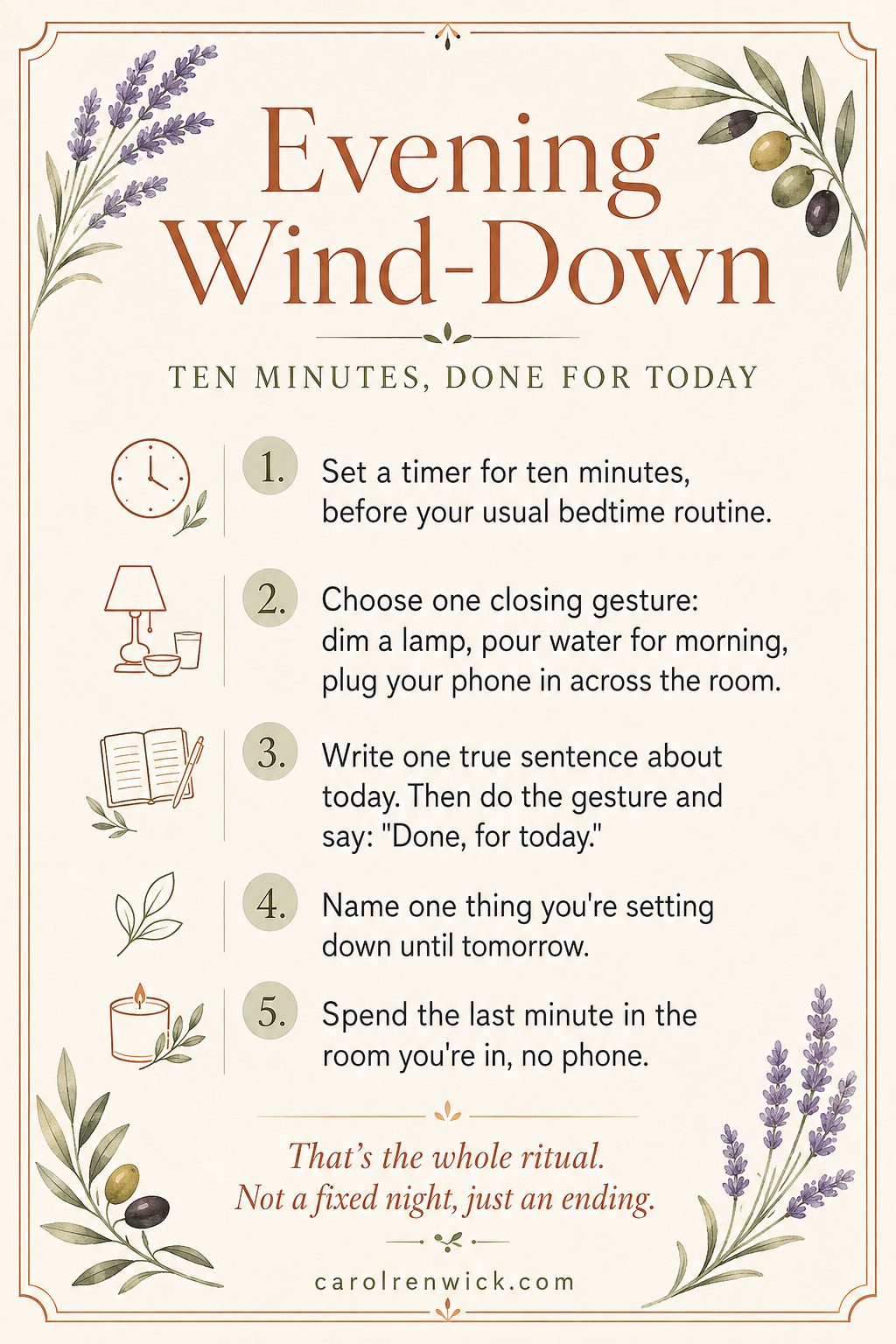
- Set a timer for ten minutes, somewhere near the end of your evening, before whatever you normally do right before bed. Choose one small closing gesture ahead of time: dimming a lamp, filling a glass of water for the morning, plugging your phone in somewhere across the room.
- Write one sentence about what actually happened today, not what should have happened. Not the tidy version. The true one: "Today I..." Let it be ordinary if it was ordinary.
- Do the closing gesture you chose, slowly, on purpose. As you do it, say to yourself, out loud or not: "Done, for today." It doesn't have to be right. It only has to be over.
- Name one thing you're setting down until tomorrow. A worry, a task, a conversation still running in your head. Say where it's going: "Not tonight. Tomorrow, if it still matters."
- Spend the last minute in the room you're actually in, no phone, noticing what's around you: the temperature, a sound, the weight of the blanket. Then go on to whatever you'd do anyway.
That's the whole practice. I don't know how tonight goes for you, and I wouldn't pretend to. What you get is an ending, on purpose, instead of a day that quietly runs past midnight without ever actually stopping.
I'm not a doctor, and this page isn't treatment for insomnia or any sleep condition, and it isn't a promise you'll sleep better tonight. It's a small ritual that has helped me feel like the day actually ended, which is a different thing, and I don't want to pretend otherwise. If sleep has been a real struggle for a long stretch, not just an occasional restless night, please talk to a doctor who can look at the whole picture. You deserve real care for that, not a page.
If writing that one true sentence felt like something, that's the whole point. Tonight doesn't have to be fixed, and there's no new routine to keep up after this. Just an ending, on your terms, for today.
With warmth from the hill, Carol