I Used to Think Rest Was Something You Earn. An Italian Phrase Talked Me Out of It.
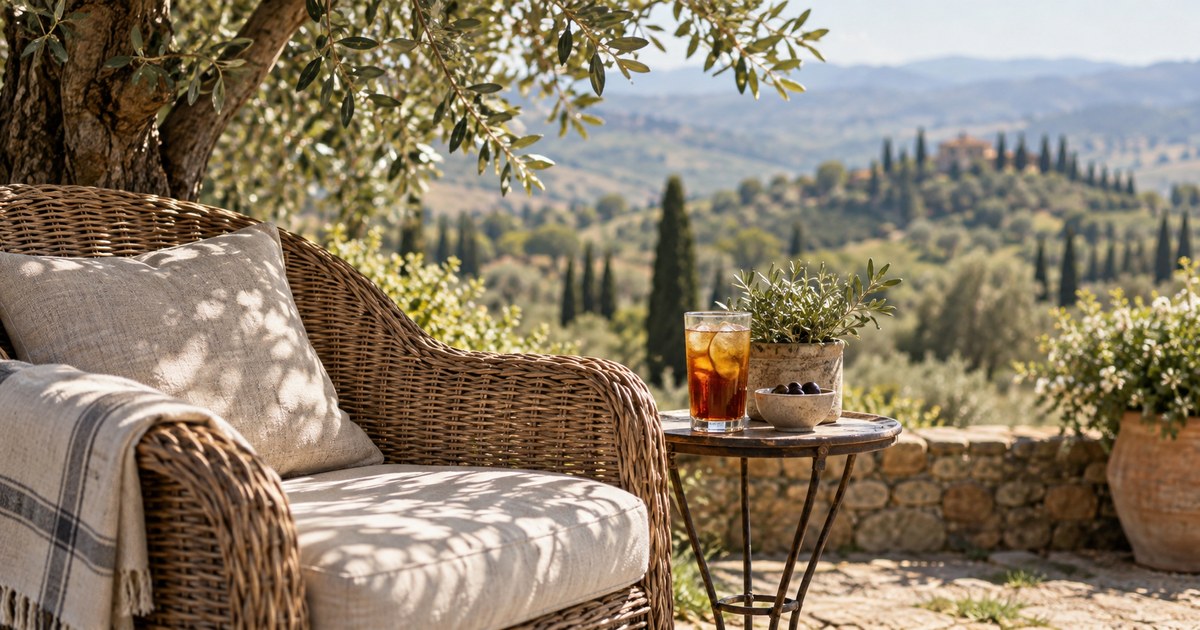
There's a phrase around here that gets printed on tea towels for tourists so often it's almost lost its meaning, and I still think it's one of the truest things I've heard since I moved to Italy: dolce far niente, the sweetness of doing nothing. I first heard it said out loud, not read off a souvenir, from the man who runs the alimentari at the bottom of the hill. I'd been sitting at his one outdoor table for nearly forty minutes with an empty coffee cup, and when he came to clear it I started apologizing, already half out of my chair. He waved me back down, said the phrase, then added, in the fond, slightly exasperated tone Italians reserve for foreigners who explain themselves too much: nobody needs a reason to sit, Carol.
I didn't have a reason. That was rather the point he was making, and rather the thing I couldn't get my head around for a long time.
A phrase built for people who don't apologize
The bench outside the pharmacy has an old woman on it most afternoons, hands folded in her lap, not reading, not doing anything with a name. For months I assumed she was waiting for someone. She wasn't waiting for anyone. She was just sitting there, sweetly and unapologetically idle, the exact thing the phrase describes, and nobody walking past so much as glanced at her twice. Nobody needed her to be resting toward something.
That's the part that undid me a little. Where I grew up, doing nothing was a thing you were allowed once you'd finished doing everything, and even then you called it a break, like a small legal exception to the rule that you were supposed to be useful. Here, the doing-nothing didn't seem to need a permit. It was just Tuesday afternoon, and a woman was sitting on a bench.
The reason I couldn't sit still
I tried it myself that same week, sort of. I carried my coffee out to the fig tree at the bottom of the garden around ten in the morning, sat down on the old stone bench under it, and lasted about four minutes before I found myself pulling weeds from around the roots with my free hand, so the ten minutes outside would count as something. I didn't plan to do that. I just noticed, eventually, that I was doing it, the same way you notice you've been holding your shoulders up near your ears for an hour.
I sat back down and made myself stop weeding, and it felt, honestly, a little like holding my breath. Not because the garden needed me right then. Because some old, well-trained part of me needed proof, before it would let me relax, that I'd done something with the morning first.
What I've been reading, and what it explained
I've been slowly working through Tara Brach's writing, and she has a phrase of her own for this that stopped me cold: the trance of unworthiness, that quiet, familiar sense that something about us disqualifies us from ease, worn in so long that most of us stop noticing it's there at all. Reading her describe it, I recognized the exact commentary that runs in my head every time I try to sit still. Not yet. Not without something to show for the morning first.
It was never really about the weeds, or the roses that didn't need deadheading. It was an old belief doing precisely what it was trained to do, which is find a small, plausible task to hand me the second I tried to just sit in the shade like the woman on the bench.
What struck me, reading Brach next to that phrase from the alimentari owner, is that dolce far niente doesn't assume you've earned your sweetness. It assumes you already have it coming, the same way the coffee comes before you've done anything to deserve it. I grew up assuming the opposite, that ease was something you collected only once you had enough proof behind you, and without that proof, sitting still just felt wrong, like stepping out of a line you weren't supposed to leave.
What I do with it now
Most mornings now, I carry my coffee to the fig tree and leave my hands empty on purpose. No trowel, no phone in my hand. Some mornings it's genuinely a little boring, and I let it be boring, because I think the boredom is part of what I never let myself have. Ten minutes, most days. I'm not claiming it fixed anything large. I'm only saying I do it now, where I used to not do it at all.
I still catch my hand drifting toward a weed sometimes. I've stopped scolding myself for that too. I just notice it, the way Brach describes noticing, and bring my hand back to my lap, and keep sitting.
If evenings are where this shows up for you
Mornings are where I lose this fight with myself, but I hear from plenty of readers for whom it happens later, that hour after dinner when the list still has three things on it and some part of you has already clocked out anyway. There's a free ten minute guide for exactly that hour, called Evening Wind Down, sitting on the site with nothing to sign up for. If your fig tree is actually a couch at nine at night, it might be worth a look.
You don't owe anyone proof before you're allowed to sit down, not the version of you doing dishes at nine at night and not the version of you under a fig tree at ten in the morning. Nobody is grading you on it. The bench outside the pharmacy is still there most afternoons, doing absolutely nothing, and as far as I can tell, nothing bad has ever come of it.