I Thought I Had to Earn My Rest. Here's What Changed My Mind.
My first October here, I walked down to the hardware store at one in the afternoon to buy a lightbulb, and found the metal shutter pulled all the way down. A handwritten sign taped to it said torno alle 16 — back at four. I stood there actually annoyed, lightbulb-less, doing the math: that's three hours, in the middle of a Tuesday, for a man to do what, exactly?
I want to tell you I found it charming right away. I didn't. I'd spent twenty years in a world where you kept going until the thing was finished, and then you kept going a little more, and stopping in the middle of a workday for no reason felt, to me, faintly outrageous. Almost rude to whoever was still waiting on you.
Nobody apologizes for the closed shop
Here's what I noticed once I stopped being annoyed long enough to actually look. From about one to four, the whole town just closes. The alimentari, the shutter guy, half the shops on the main street. Old men sit outside the bar playing cards like it's the only thing on their schedule, because for those three hours, it is. My neighbour Elena disappears into her house and I don't see her again until the light changes and she's back out watering the tomatoes.
Nobody puts up a sign that says sorry for the inconvenience. Nobody explains themselves. Nobody earns it with a good morning, and nobody loses it to a slow one. It just happens, on schedule, built into the shape of the day the same way the walls are built into the house. You don't have to justify a wall to anyone.
I'd spent my whole adult life treating rest as the thing you got to, eventually, if the list ever ran out. It never ran out. So neither did I, most days — I just kept going until I physically couldn't, and then I'd collapse onto the sofa feeling vaguely guilty about it, like I'd been caught doing something I hadn't cleared with anyone.
The chair I almost didn't buy
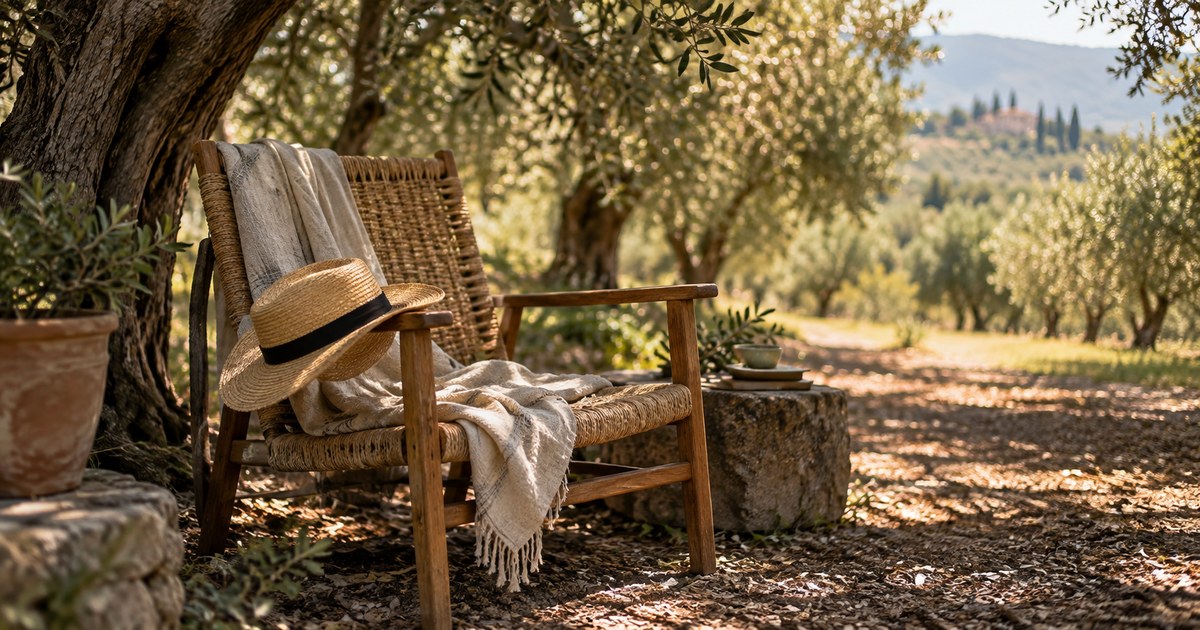
There's a stall at the Saturday market that sells old furniture somebody's cleared out of a farmhouse — chipped dressers, mismatched chairs, that sort of thing. One week there was a wicker chair, sun-bleached almost white, with nothing wrong with it except that it wobbled slightly on the stone. Twelve euro. I stood there for a long time working out reasons I was allowed to buy it.
I told the man I could use it for when guests came. I told myself it would look nice on the terrace, which was true, and also not the reason I wanted it. The real reason was that I wanted a chair whose only job was to hold me while I did nothing in it — no ironing pile balanced on the arm, no laptop, nothing to show for the twenty minutes. And some old, well-worn part of me needed a story to tell myself before I'd hand over the twelve euro for that.
I bought the chair. I still catch myself doing this, though — rehearsing the justification before I let myself spend a little money on something that exists purely for my own comfort, as if pleasure needs a receipt to be legitimate.
What I've been reading, and what it explained
I've been slowly working through Kristin Neff's writing on self-compassion, and there's a question of hers I keep coming back to: would you say this to a friend? I never once thought Elena needed to earn her afternoon rest with a productive morning first. I would never tell a friend she needed a good enough reason to buy herself a twelve-euro chair. So why did I have a whole set of rules for myself that I'd never once apply to anyone I actually loved?
I don't think the guilt was really about the chair, or the shutter guy's three hours. I think it was an old belief, the kind you absorb so early you stop noticing it's there: that rest and small pleasures are a reward you collect after you've proven yourself, and if you haven't proven yourself yet today, you don't get to collect. Under that belief, the finish line just keeps moving. There's always one more thing that could get done first.
What's actually true, I think, is smaller and kinder than that. Rest isn't a reward, I don't think. It's more like maintenance — the same care I'd hand a friend without thinking twice. I gave that kind of care to everyone in my house for years. Just never to myself.
What I do with the hours now
I keep something close to riposo now, even working from my own kitchen table where nobody is enforcing it. Around one, I make tea and sit in the wicker chair for twenty minutes, sometimes with a book, sometimes with nothing at all, and I've stopped needing a reason on hand in case someone asks. Some days it's genuinely dull. I still do it.
If you'd like one small, free way to start noticing where you're still waiting for permission, I put together a ten-minute practice called One Small Thing. No email required, right there on the page.
You didn't fail some test that would have earned you the right to sit down. There was no test. There's just a habit of waiting for one, and habits, unlike tests, can be unlearned — a little at a time, the way everything worth changing seems to happen around here.
If you want a place to keep this
This is close to what I made The Gentle Check-In Daily Journal for. It's not a productivity tracker and there's nothing to complete before you're allowed to use it — no streak to keep, no box you have to earn by filling the ones above it first. Just a small daily page for noticing the maintenance you already gave yourself: the twenty minutes, the tea, the chair. Somewhere for it to count, even on the dull days.
No pressure at all if a free practice is plenty for now. That's enough, honestly. But if some part of you is still standing in front of that shuttered store doing the math on whether you've earned the right to stop — you have. You always did.